
October 2021 • Figma
the Foody app
How can an app help users find a place to eat while simultaneously enticing them to leave reviews?
Overview
My Role:
Problem:
Goal:
I independently performed all of the research and designed all of the components for this project.
This is a fictional project completed to fulfill a prompt in my bootcamp course.
Create an app that both helps users find a restaurant to make a reservation and entices them to leave reviews.
1. To allow users to apply extensive filters when searching for a restaurant.
2. To raise incentive for users to make reviews.
3. To allow users to share recommendations easily.
4. To give restaurants a platform to be discovered.
Design Process

Proposal
Since I was given free liberty with this project, I proposed an app that combines social media with restaurants.
The amount of reviews and the star rating of a restaurant were the main characteristics that users looked at while searching for a restaurant. By creating an app that allows people to rate and review restaurants on a social media-like platform, users will be incentivized to leave reviews more often by gaining “likes” and “followers.” They also will be allowed to share restaurants, cafes, bakeries, etc. with friends much faster.
Audience
Target User and Market:
People in their 20s-50s who already have a social media presence.
Audience Statements:
The user is a ____ who wants to ____.
-
college student; find a cheap dinner
-
father; reserve a table for his child’s bday
-
30-year-old; meet friends for happy hour
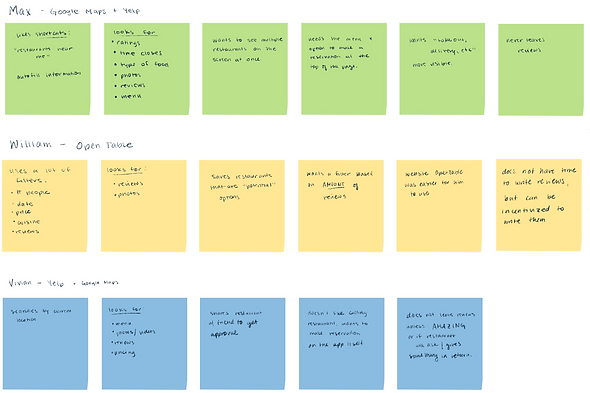
Potential User Interviews:
I selected a younger audience as the users because they are more likely to book reservations using an app on their phone. I chose this category of people to understand what is most important to them and what they typically ignore while making a reservation.
Focus
I wanted to make sure that the filters mentioned the most frequently were easily seen throughout the app. Furthermore, most users are not inclined to leave reviews, meanwhile reviews are utilized the most often when looking for a place to eat. By creating a social media-type platform, users will more likely share where they went to eat with their followers and/or friends.
Design Principles
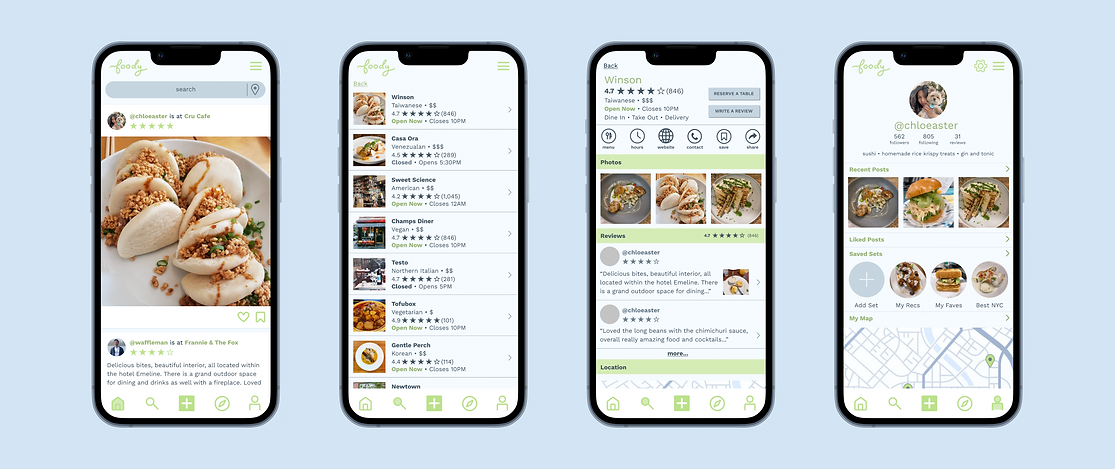
I wanted to create a minimal, refreshing, and inviting interface to encourage users to browse restaurants comfortably. Though simple, each page was designed to maximize the visible screen area, allowing the user to find most of what they are looking for without scrolling.
To quickly envision how the app would function, I created a low-fidelity wireframe:

Color Decision:
I went with a more muted color palette of greens and blues, which contrasts greatly with some of competitors. The goal of this muted palette is to bring focus to what matters to the user, such as the images shared by users and restaurants. I did not want to distract the user with bright bold colors.
Prototype:
With a few tweaks, I then created a clickable prototype of the app using Figma.
Peer Feedback
I interviewed potential users once I created a prototype of Foody and assessed how well they were able to perform tasks:
-
Booking a reservation
-
Adding a new post
-
Viewing your most recent posts
Users moved around the app with ease since the layout was similar to other social media platforms. They also seemed interested in the “social media aspect” and suggested having it even more involved, such as filtering restaurants based on places your friends went. By relying so heavily on those you follow for reviews, users would be more inclined to set reviews themselves especially if they know it helps a friend out.
From these interviews, I added two main features:
-
An explore page because the users wanted to a place to see places and posts from those that they do not follow
-
A filter for only showing places that friends reviewed because the users wanted to just see places visited by those they trust


The Final Product


Reflection
This is the first complete UX design project I have completed from research to design, so there was a lot to learn along the way. I had a lot of fun learning how to work with a new program, and I was excited to work on both my graphic and UX design skills. While I was not about to see the app come to fruition, I was proud of the final result.
The biggest challenge I faced while completing this project was not being able to collaborate with others. I developed all of the ideas and designs and did not get much feedback except from the interviews I performed with my volunteers. Working with a team would help me flesh out my ideas and gain inspiration from others.
If this app were to be built, the biggest challenge it may face is collecting and displaying all of the necessary information for each restaurant (reviews, websites, hours, etc). One solution would be taking the information from GoogleMaps or Yelp, two sources that already have many restaurants in their system. Another weakness would be getting users to sign up since there are already platforms that you can share food pictures on. Perhaps, the app would be able to team up with Instagram or Facebook and allow users to post the same photo on both their platform and Foody simultaneously.
Overall, I enjoyed the process of creating an entirely new social media platform from scratch. I believe there would be a wide range of people who can benefit from seeing how their friends and family review restaurants all around the world.